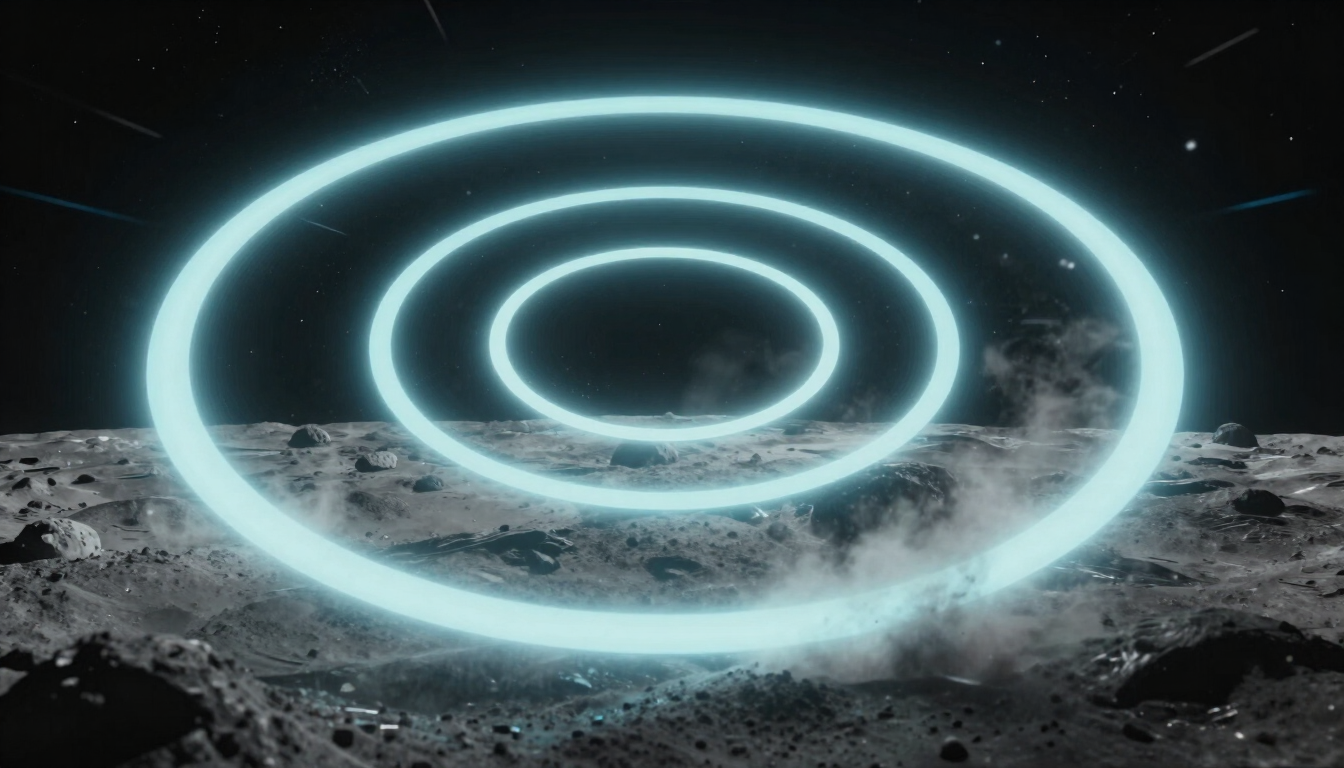
The year is 2251. Deep beneath Crater Clavius on the Moon, a secret international agency called MMDI operates the only working time travel facility in human history. Its agents are young men recruited from Earth, housed in a labyrinth of corridors cut into lunar rock, and sent backward through time to carry out missions their commanders define and withhold in equal measure.
The agency exists because the capability of human time travel was given to humanity be highly intelligent extraterrestrial aliens from a distant galaxy. The first country to develop the human use of time machines is China. In the 22nd century, Chinese scientists achieved the first successful human travel in time to the past, but killed people living above ground where the secret facility was situated. Rather than suppress the discovery, the Chinese government help to create an international body with a controlled program. MMDI was the result: a multinational directorate with one mandate, a budget that does not appear on any public ledger, and there is a black site base that no government officially acknowledges.
Vincent Wauneka is one of MMDI’s most accomplished operatives. A Navajo from Arizona, fluent in eight languages and trained in the psychological arts of recruitment and manipulation, this man has completed more missions to the twentieth century than almost any other agent on the roster. His current assignment has sent him back to 1991 Arizona over seventy times, scouting candidates along desert highways and reservation roads, looking for the one man the Directorate has decided it needs.
Above him in the chain of command sits General Chaz Yang, MMDI’s director and the most feared figure on the lunar base. Yang is fifty-five, Chinese-born, raised in Beijing, and possessed of a temper calibrated to keep every man in his orbit slightly off-balance. He rewards compliance with a phrase — “kiss, kiss” — that carries more menace than affection. He controls the mission logs, the return schedules, and the careers of every agent who steps into one of the blue glass chambers and disappears.
The blue glass chambers are the heart of the facility: massive circular devices the agents have come to call Giant Blue Hockey Pucks. A man enters naked, and the device fills with a thick, foul-smelling white propellant that spins him through time. He materializes in the past fully clothed, costumed by machinery that replicates whatever era he has been sent to. He returns the same way — naked, disoriented, drenched in the propellant, standing in front of uniformed men who demand the code word of the day before they will let him back into the base.
What the agents are not told, and what the novel moves toward revealing, is the true reason MMDI was founded. Beneath the base, deeper than any inhabited level, something was discovered in 2192 that rewrote every assumption human civilization had made about its own uniqueness in the universe. The Directorate has kept that discovery secret ever since. The time travel program is not the point. It is the cover.
Clavius Deep is the story of a young Navajo operative who is very good at his job and slowly becoming aware that the job is not what it appears. It is the story of a general who commands absolute loyalty from men he treats as interchangeable. And it is the first novel in The Clavius Harvest series from author Madeira Desouza — a wild ride that shows what humanity is prepared to do when our species discovers we have never been alone.
- Genre
- Science fiction / time travel / lunar setting
- Length
- Full-length novel (112,000 words)
- Publisher
- Independently published via Amazon KDP
- Formats
- Kindle Unlimited, Kindle ebook, paperback, hardcover
- Content note
- Adult themes, explicit content, psychological pressure, institutional coercion
- Author
- Madeira Desouza
Comparable Reads
If you enjoy Clavius Deep, you might also appreciate these science-fiction works that explore similar themes:
Blindsight by Peter Watts
Like Clavius Deep, Blindsight engages rigorously with first-contact scenarios that are intellectually unsettling. Both novels foreground the challenge of understanding alien intelligences that operate outside human sensory and mental frameworks. The cold, clinical atmosphere of mission teams facing incomprehensible otherness creates a similar sense of cosmic unease.
The Sparrow by Mary Doria Russell
The Sparrow explores first-contact, religion, and the moral costs of intercultural and interspecies encounter. If you're drawn to how Clavius Deep interrogates religious formation around an extraterrestrial phenomenon and the ethical consequences for those caught between worlds, The Sparrow offers a complementary exploration of spiritual and moral fallout from alien contact.
Childhood's End by Arthur C. Clarke
Clarke's classic examines what alien benevolence—or inscrutability—does to human institutions, religion, and identity. Clavius Deep similarly presents an alien encounter that reorders human belief systems and asks how humanity adapts to being objectively known and influenced by nonhuman intelligences.
The Three-Body Problem by Cixin Liu
Liu's novel shares the scale of consequence and geopolitics surrounding an extraterrestrial discovery. Both texts tie scientific revelation to international institutions and explore cascade effects through time. If you appreciate the institutional and political dimensions of Clavius Deep, you'll find similar themes in the clandestine scientific history and cross-national consequences of The Three-Body Problem.
11/22/63 by Stephen King
King's time-travel novel offers a strong point of comparison for its narrative emphasis on the moral complexity of changing the past and the psychological cost for the time traveler. Clavius Deep shares this focus on mission-oriented interventions in historical timelines and investigates the personal and institutional fallout of repeated timeline alterations.
Permutation City by Greg Egan
Permutation City explores consciousness, identity, and simulation in ways that echo the alien intelligence at the heart of Clavius Deep. If you're intrigued by questions of what consciousness is and how it might operate outside human parameters, this novel offers a rigorous exploration of those themes.
Hyperion by Dan Simmons
Hyperion is an epic science-fiction work that weaves together institutional power, time manipulation, and moral complexity across multiple timelines. Readers who appreciate Clavius Deep's scope and its examination of how individuals navigate vast institutional forces will find much to engage with here.
Altered Carbon by Richard K. Morgan
This novel explores consciousness transfer, institutional control, and questions of identity and embodiment. If the themes of consciousness and bodily autonomy in Clavius Deep resonate with you, Altered Carbon extends those questions into a noir-inflected future.
The Quantum Thief by Hannu Rajaniemi
The Quantum Thief weaves together time, memory, identity, and alien intelligences in a complex, intellectually demanding narrative. Readers drawn to Clavius Deep's exploration of how memory and identity are shaped by forces beyond individual control will find this novel rewarding.
Ancillary Justice by Ann Leckie
Ancillary Justice examines consciousness, institutional power, and non-human perspectives in ways that complement Clavius Deep's interrogation of what it means to be an agent—both as an individual and as part of a larger institutional apparatus.